Machines that sense, decide and act.
We design robots as complete systems: the structure, the actuators, the electronics, the control loop and the intelligence on top. If it has to move something in the real world and keep doing it, this is the discipline.
What we build.
Specific things we design, build and test in this discipline.
Multi-axis arms
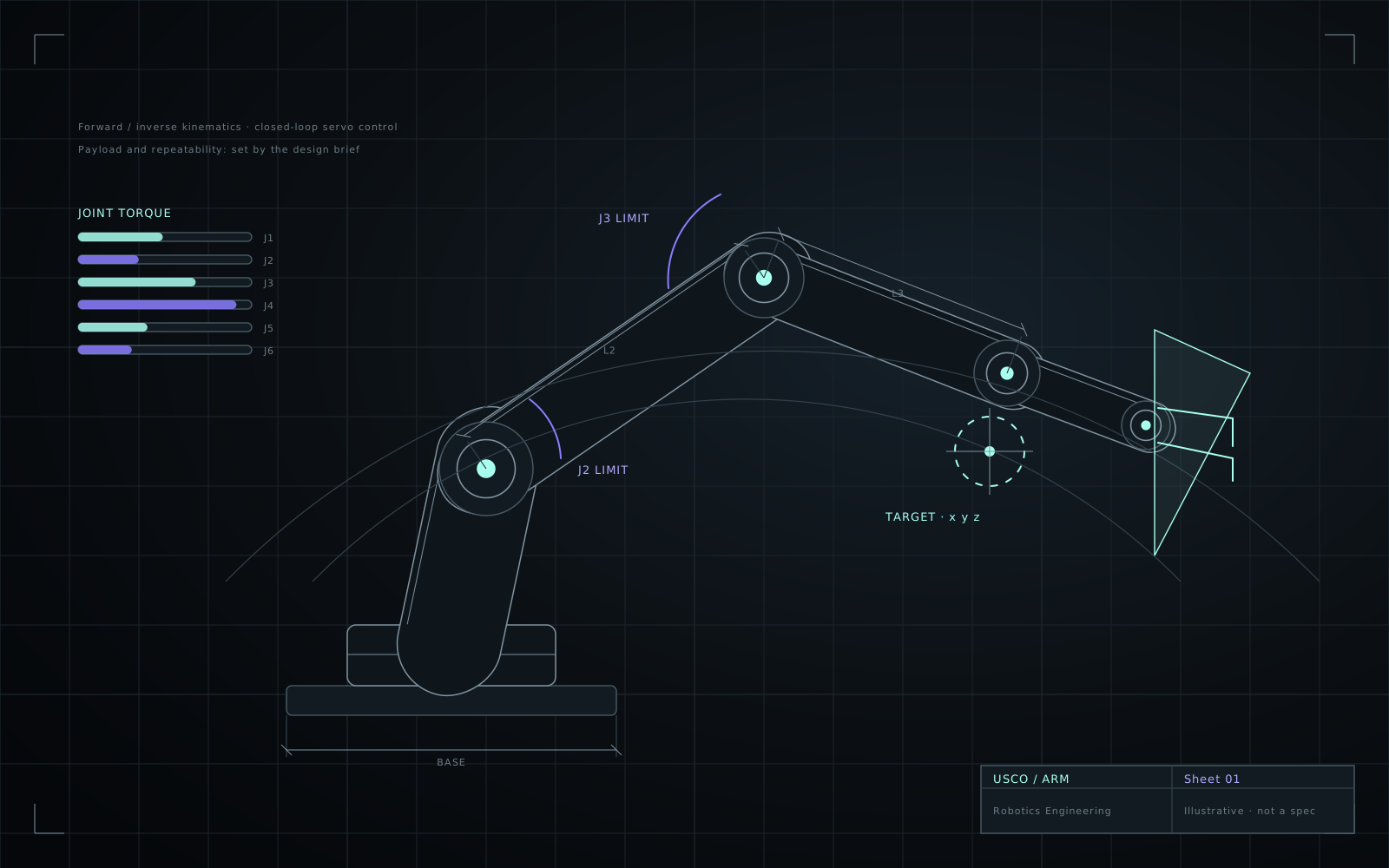
Six- and seven-degree-of-freedom manipulators: kinematics, joint limits, payload and repeatability worked out before anything is cut or printed.
Motion control
Servo and stepper drives, closed-loop position and speed control, trajectory generation and safe stop behaviour.
Vision-guided manipulation
A camera finds the object or the board; the arm moves to it. Calibration, coordinate mapping and pick-and-place that repeats.
Assistive and human-machine robotics
Robotic limbs and interfaces driven by biosignals such as EMG, treated as research until properly validated.
Mechanical design for robots
CAD, 3D-printed structures, brackets, grippers and end effectors, iterated against real test results.
ROS and system integration
Nodes, topics and message flow that let perception, planning and control run as one system rather than three demos.
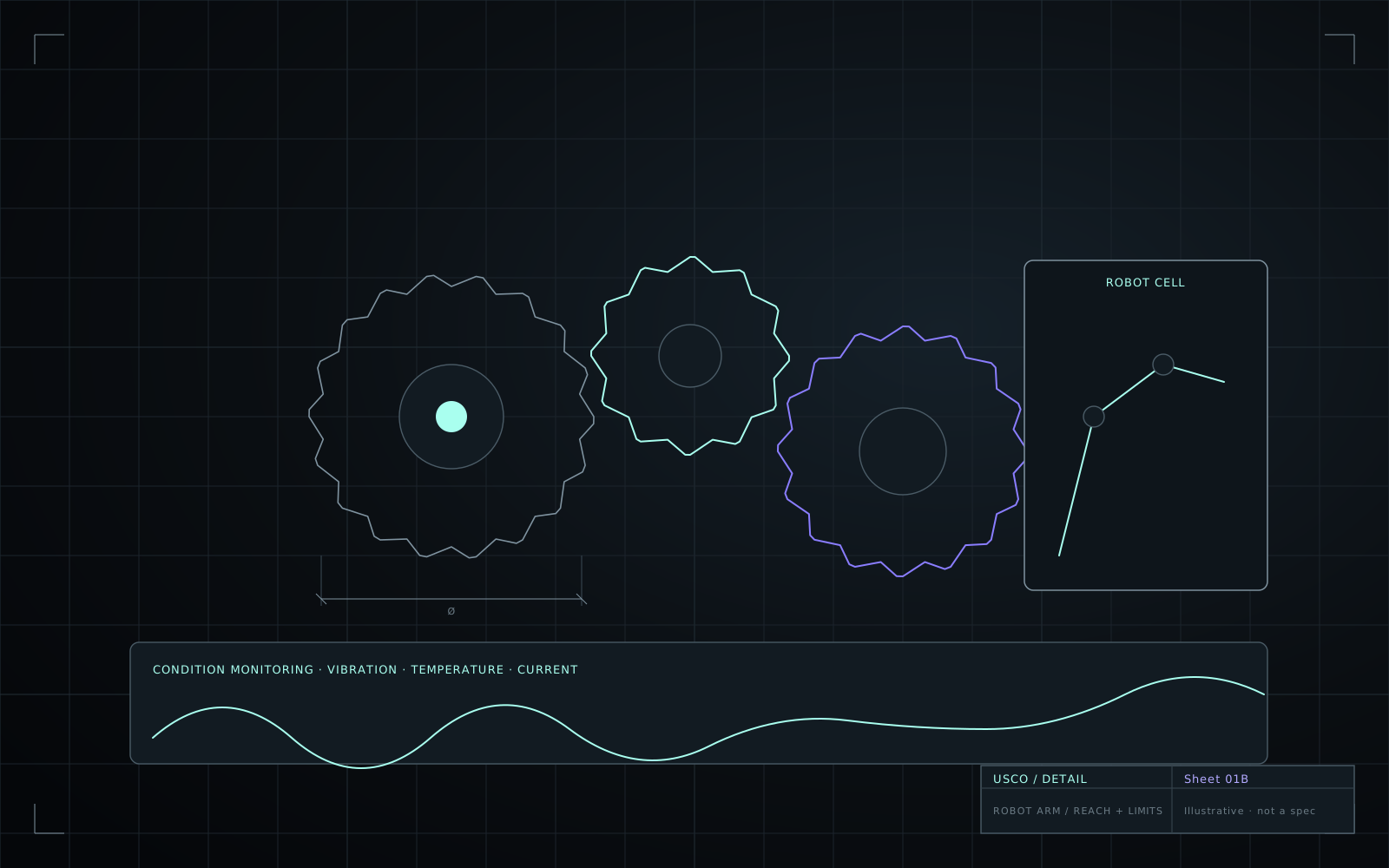 ROBOT ARM / REACH + LIMITS
The envelope is designed first.
Where the arm can reach, how much it can lift and how precisely it can come back to the same point decide the whole machine. We model reach, torque and joint limits up front so the hardware you pay for matches the job.
From the task to a robot that repeats it.
Define the task
What must move, how far, how fast, how often and what happens when something goes wrong.
Model the machine
Kinematics, torque and reach on paper, then a rough mechanical layout.
Build and instrument
Print, assemble, wire and add sensing so the machine can report on itself.
Tune and prove
Calibrate, run the task hundreds of times, log failures, fix the cause rather than the symptom.
What it is built with.
Tools and platforms we choose from, picked per project, never by habit.
- Actuation
- Hobby and industrial servos, stepper and DC drives, gearboxes, grippers
- Control
- Microcontroller and single-board-computer control, PID loops, inverse kinematics
- Perception
- Cameras, depth and distance sensors, encoders, force and current sensing
- Software
- C/C++ firmware, Python, ROS nodes, OpenCV
- Structure
- Aluminium profile, sheet parts and 3D-printed PLA / PETG / ABS components
Evidence, not adjectives.
Projects where this capability is documented, with their real stage.
A robot is a loop, not a limb.
Perception, decision and actuation have to be designed together. Most robots that disappoint were built as a beautiful arm with a control problem added later.