A clear process for difficult work.
Hard engineering should be understandable without being shallow. This is how a project moves from a conversation to a system that runs, and what you see at every step.
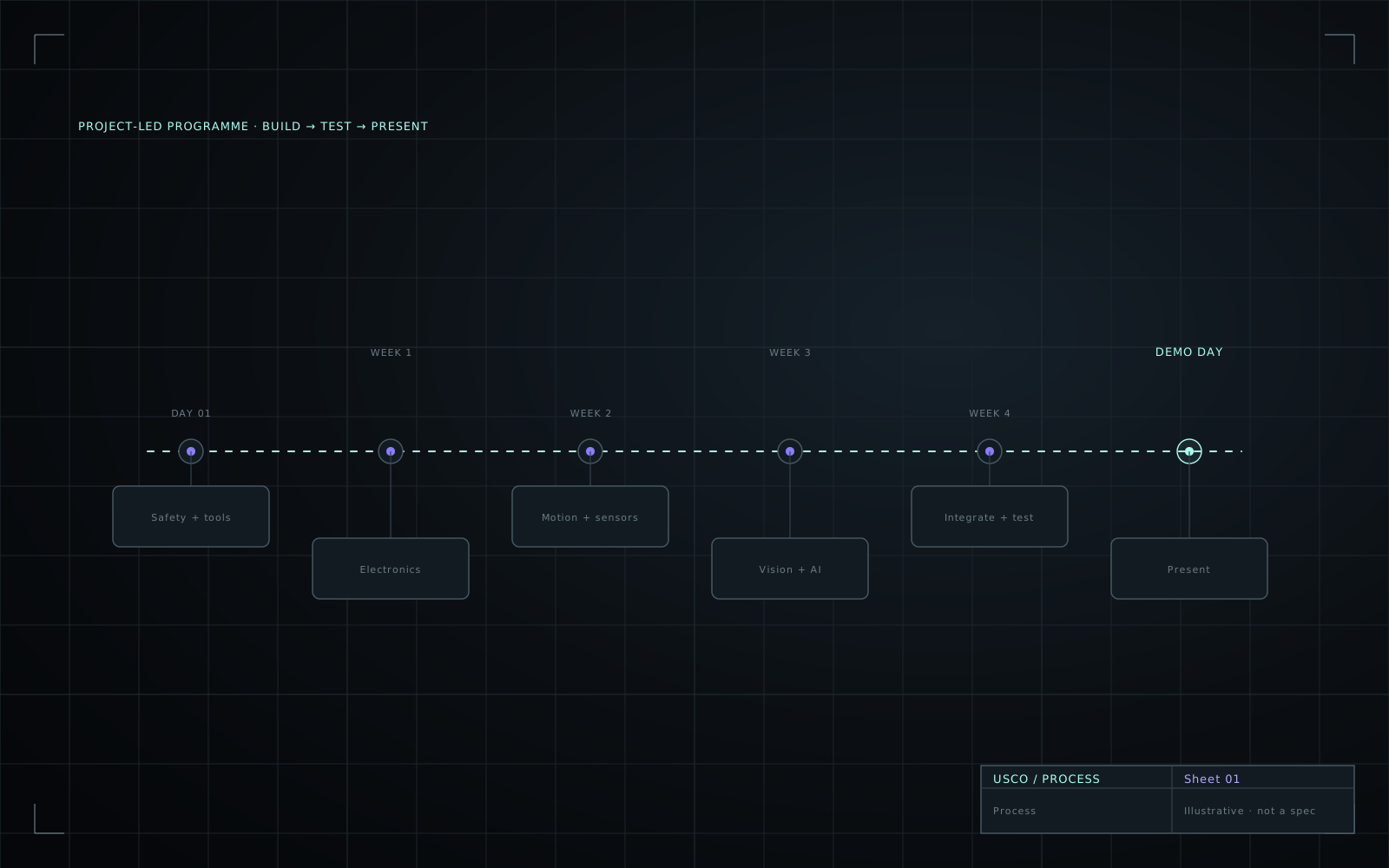
Six stages.
Not every project needs every stage. Each one is agreed in writing.
Understand the problem
Who has it, what it costs them, what they do today. We ask for the failure before the feature.
Design the system
How hardware, firmware, intelligence and software fit together; a written architecture and a list of risks.
Build a prototype
The smallest working version that tests the core idea. You see it running early.
Test it
Bench tests and, where possible, tests in the real environment. Failures are recorded, not hidden.
Improve it
Changes driven by evidence: mechanical, electronic, software or model.
Prepare for use
Documentation, handover and a plain statement of whether the result is a concept, demonstrator, field-tested or ready to produce.
What you can expect from us.
Plain status
Every system is labelled concept, demonstrator, field trial, deployed or production-ready.
Early visibility
Working builds and test logs shared as we go, not a reveal at the end.
Evidence for claims
We state what was tested and how, or we do not make the claim.
Documented handover
Drawings, code, bills of materials and notes your team can maintain.
Local serviceability
Parts and designs chosen so they can be repaired in Nigeria.
Straight talk
If something is not feasible, or not yet a product, we tell you early.