Give machines the ability to understand what they see.
A model that works on a laptop is the beginning, not the product. We build perception systems end to end: the data, the model, the hardware it runs on, the alert it sends and the conditions it has to survive.
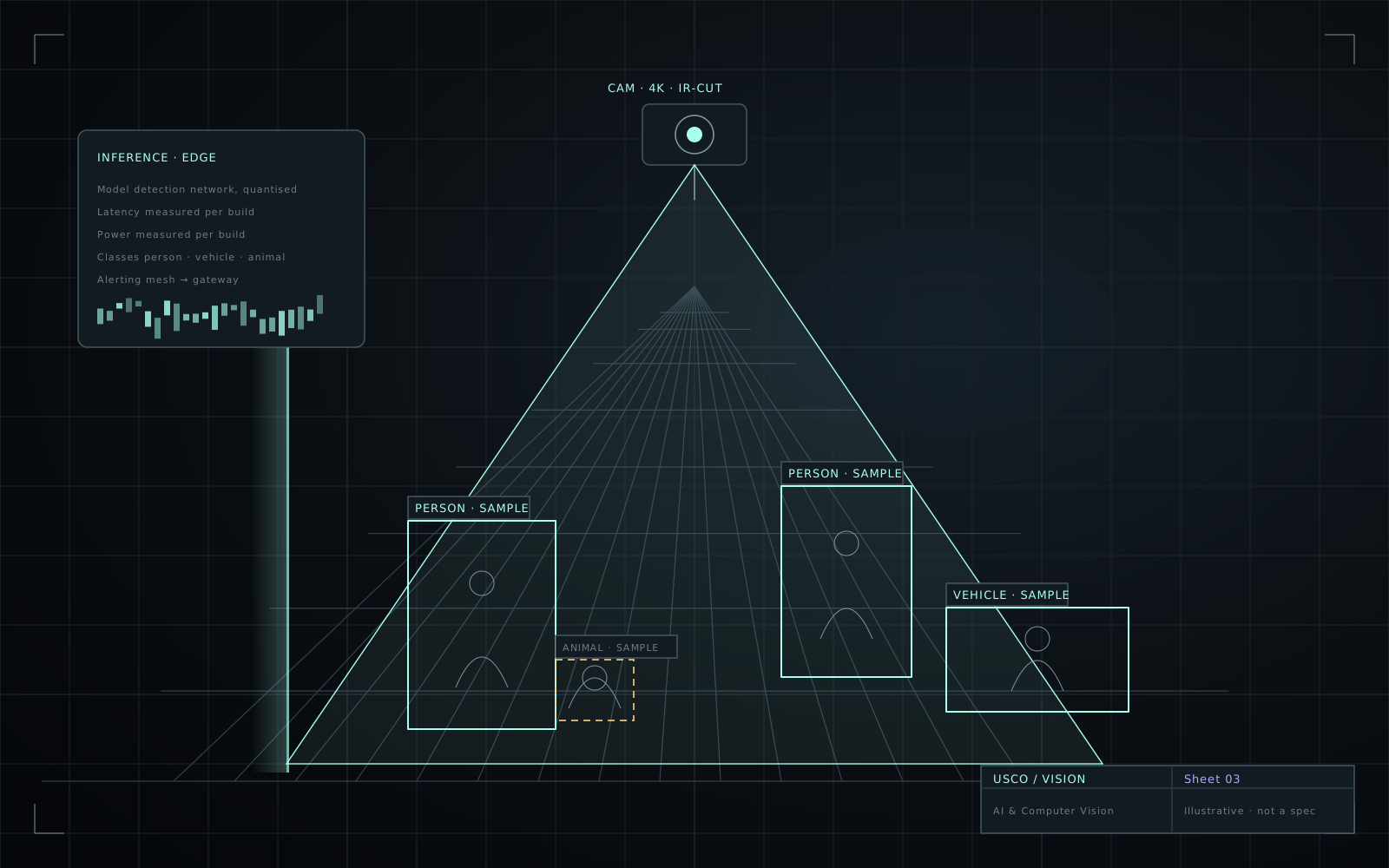
What we build.
Specific things we design, build and test in this discipline.
Detection and classification
People, vehicles, animals, defects, objects of interest. Models chosen for the job rather than for the headline.
Edge deployment
Quantised models running on single-board computers and accelerators, so the system works without a data centre.
Data pipelines
Collection, labelling, augmentation and versioning. Most accuracy is won or lost here.
Vision-guided automation
Camera output turned into motion: sorting, pick-and-place, board and object tracking.
Monitoring and alerting
Event logic, thresholds and notifications that reduce noise instead of generating it.
Local language models
Assistants that run on site, for private control of devices and information without a cloud round-trip.
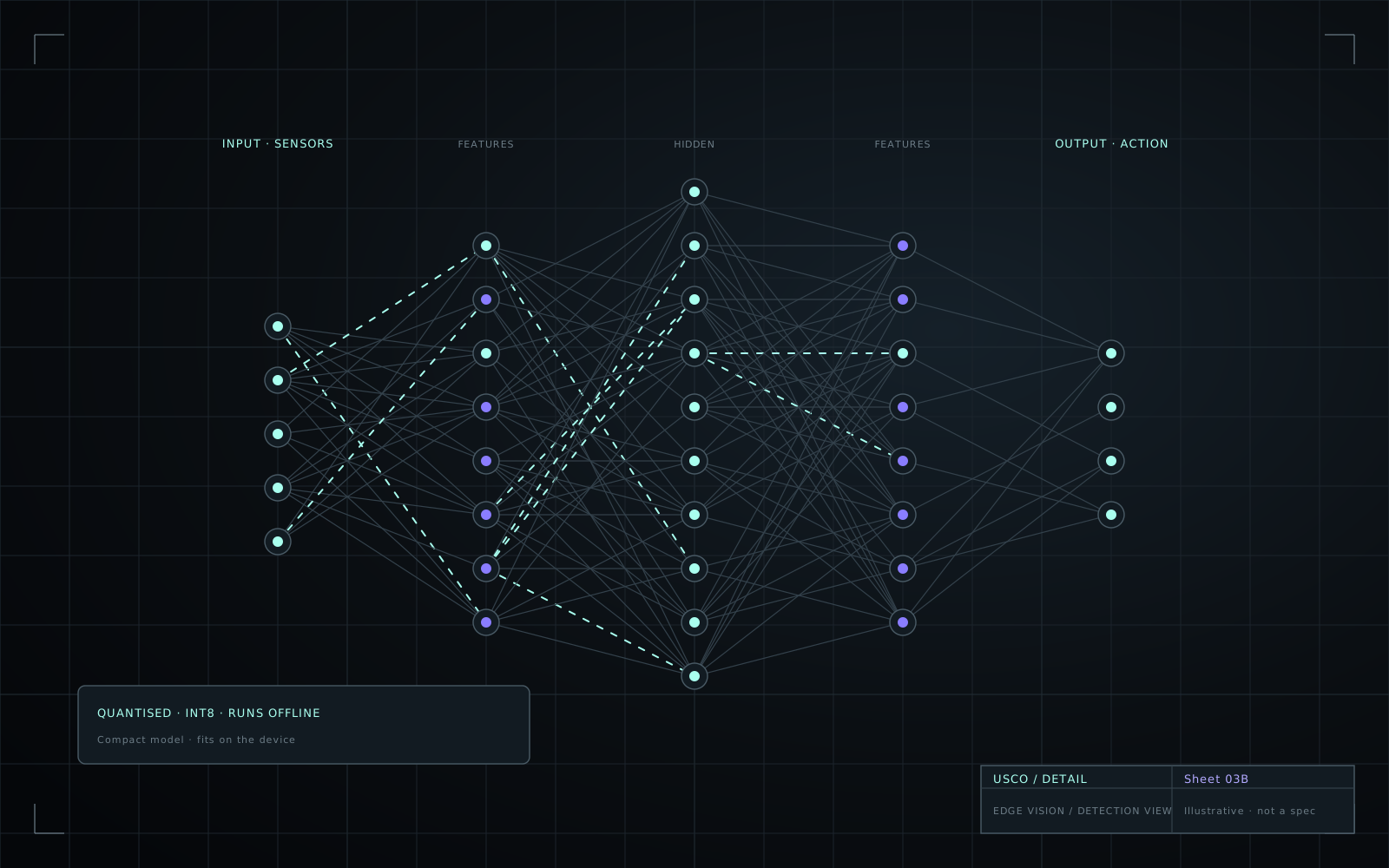 EDGE VISION / DETECTION VIEW
Accuracy is a claim. We show the test.
We report what was tested, on what data and how errors were counted, including false alarms and misses. A number with no test behind it is marketing; one with a test behind it is engineering.
From a question to a model that holds up outside the lab.
Frame the decision
What must the system notice, how fast, and what does a wrong answer cost?
Collect and label
Gather data in the real environment, because stock datasets do not look like your site.
Train and compress
Train, evaluate on held-out data, then shrink the model to fit the target device.
Field-test and tune
Run it in place, count correct detections, false alarms and misses, then retrain on what failed.
What it is built with.
Tools and platforms we choose from, picked per project, never by habit.
- Frameworks
- PyTorch / TensorFlow-class training, OpenCV, ONNX-style export
- Targets
- Raspberry Pi-class boards and edge accelerators, plus workstation GPUs for training
- Methods
- Object detection, classification, tracking, segmentation, quantisation
- Language models
- Local inference for private, offline assistants
- Evaluation
- Held-out test sets, confusion matrices, false-alarm and miss rates
Evidence, not adjectives.
Projects where this capability is documented, with their real stage.
Start with the failure, not the model.
We do not begin with where AI could be used. We begin with what goes wrong today, who it affects and what a useful alert looks like.