Cybersecurity through responsible practice.
We teach how systems are defended, how they fail and how to test them safely and legally. Every lab runs on equipment we own, inside a controlled environment, with ethics taught first.
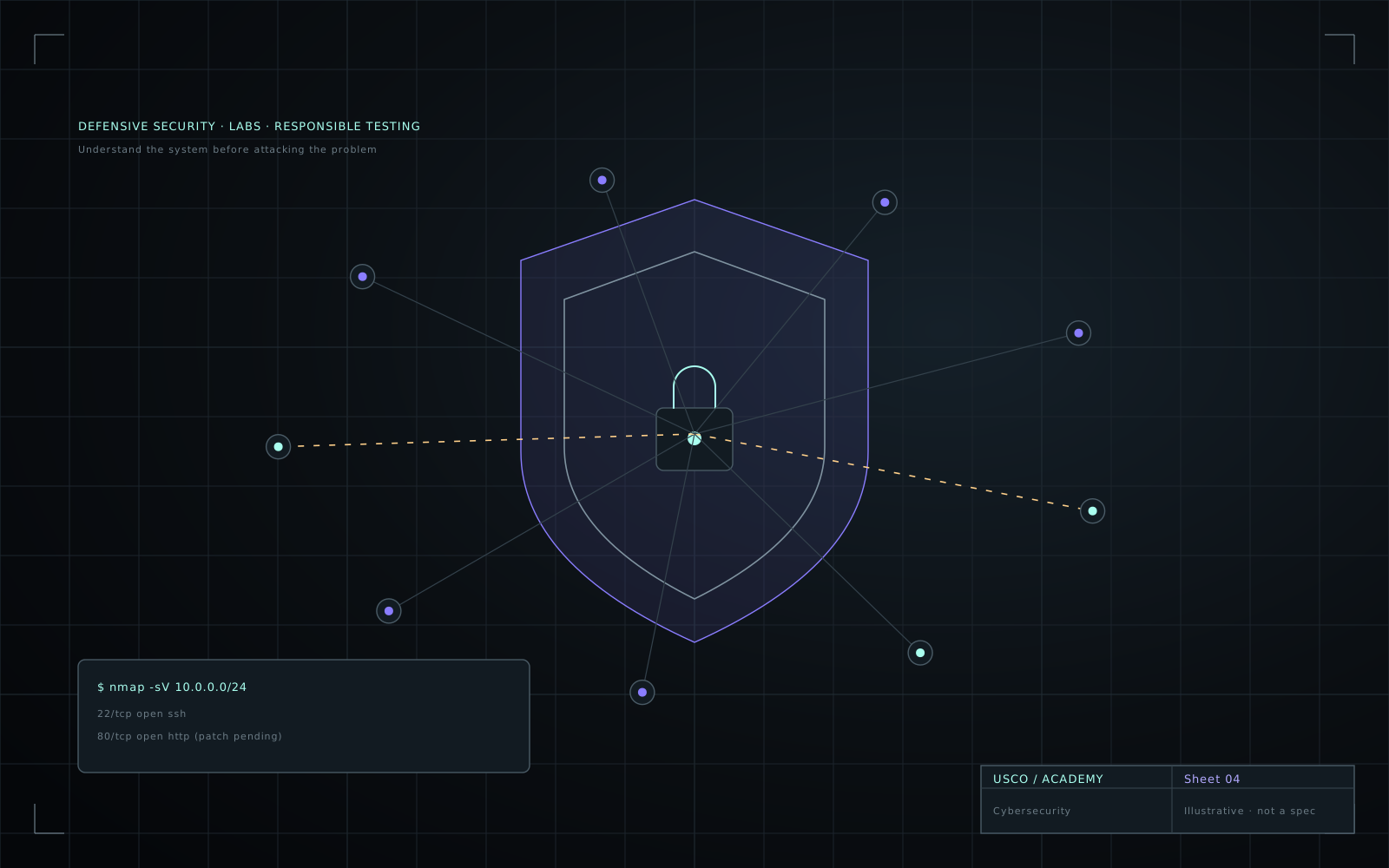
What learners get good at.
Six capabilities, built through projects rather than slides.
Security thinking
Assets, threats, risk and the habit of asking what could go wrong.
Networks
How data travels, how networks are built and how they are mapped and monitored.
Application security
Common web vulnerabilities and the coding habits that prevent them.
Defensive practice
Passwords, updates, hardening, logging and recovery.
Safe, legal testing
Responsible testing inside labs we control, with permission and rules of engagement.
Securing connected devices
Why IoT devices are targeted and how to build them safely.
The learning path.
Every course follows the same five-step rhythm.
Ethics first
Rules, law and consent before any tool is opened.
Understand the system
Networks, servers and applications.
Find the weakness
Controlled labs on our own equipment.
Fix it
Patch, harden and verify.
Report it
Write findings clearly for a non-technical reader.
What gets built.
Learners choose and shape their projects, with a coach to guide the engineering. These are common starting points.
- Who it is for
- Learners aged roughly 10 to 25. Entry level is set per cohort; ask us where your child or team should start.
- Format
- Cohort-based, hands-on, project-led. In person at the USCO lab in Ikeja, in schools, or virtual where the subject allows.
- Class shape
- Small groups of around five learners per coach in the lab, so everyone touches the hardware.
- Ground rule
- Everything is tested only on systems we own or are explicitly permitted to test
- Dates and fees
- Set per cohort. Message us for the current schedule; we reply within one working day.
“Make something you can explain, repair and improve.”
That sentence is the test every project has to pass before a learner presents it.